 |
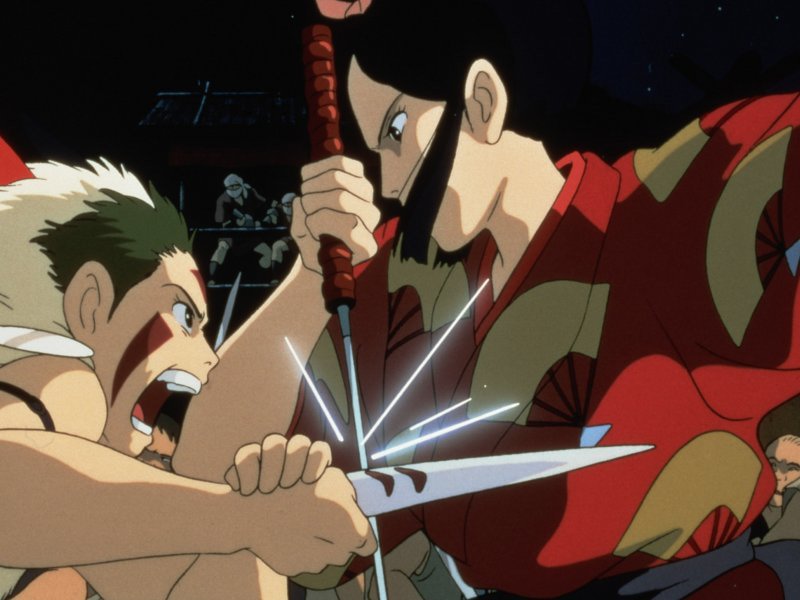
| Lady Eboshi vs. San Lady Eboshi wasn’t a one dimensional villain that can be seen in many films. She’s the one that is leading the destruction of the forest and its spirit creatures, but she isn’t doing it for her own personal gain. Eboshi was trying to great a society where the outcasts of society could feel safe and take control of their own lives. However, Eboshi ignores the dangerous prices that would have to be paid to create this utopia. She’s fueled by a hatred and determination to destroy the spirit creatures she feels are preventing her people from truly succeeding. Eboshi could protect her people and create a safe haven for the outcasts, but it’s difficult when her means of doing this are to destroy everything around the island. San is another character who displays qualities that could be considered good and evil. All her actions are the result of a hatred of humanity that has built up throughout her life in the forest. She almost kills Ashitaka because she feels as if she can never be a part of human civilization because of all the evils that humans have done that harm her home. At the same time, though, San is very protective of her family and it’s obvious that she loves them. She feels the need to protect those in the forest that are suffering, even if it may bring harm to herself. San is a balance of hatred and a fierce protectiveness and love for her home and family. I think that the ending for both of the characters was very ambiguous. Eboshi claims that she will start over and make their village better, but there is no guarantee that she has learned her lesson or will not go back to her old ways eventually. Also, though San has learned that there is at least one human that she knows who is not evil or set out to harm the forest, she still states that she can never forgive humans for what they have done. However, if the people on the island decide to try to live in harmony with nature, there is a possibility that her mind will change. It’s really up to the viewer’s judgment. |
Tuesday, March 27, 2012
Simms - Hate and Redemption in Princess Mononoke

Friday, March 23, 2012
Simms - The Choice to Rebel
 |
| Ah My Goddess The issue of free will is shown in how Belldandy and Keiichi really don’t want to be involved in Celestine’s plan of a utopia, but they keep finding themselves involved without really having a choice in the matter. Belldandy felt a certain obligation to Celestine because he was her mentor and that also gave him the opportunity to involve her in his plans and erase her memories of the person she loved. The virus that she was infected with also forced her into a situation where the higher up gods would have to perform a dangerous vaccination. I really think that Keiichi was a puppet to Celestine’s plans also. Keiichi is possessed by Celestine because the god knows that Belldandy wouldn’t harm him. Under this possession, Keiichi was also made to release the virus that executed Celestine’s plans. To a degree, Celestine probably felt that his choice to destroy the world and start a new one was the only thing that could be done to eliminate suffering. The Gate of Judgment is also an example of how gods don’t really have the choice to be with the humans that they love, they are forced to go through the task of the Gate. Celestine’s rebellion was very interesting because it wasn’t really a plot that was directed for his personal gain. He looked at the Gate of Judgment as it hurt so many people and he witnessed the suffering that the humans from lower worlds were going through and felt as if the other gods had no desire to aid them. He truly believed that if he started the Earth anew, it would lead to the end to all the suffering that took place on it. Celestine was also motivated by the idea of a world where Belldandy would not have to witness the atrocities that took place. He had good intentions, but I feel as if his plans could possibly lead to the suffering that he was trying to avoid. Furthermore, I felt that Celestine was behaving in the same manipulative manner that he accused the other gods of displaying. He was using those around him (Belldandy, Keiichi) to put them in the position where they did not have a choice, and his actions caused them suffering. However, from Celestine’s perspective, I believe that he felt that the end justifies the means. |
Wednesday, March 14, 2012
Simms - Children Without Support
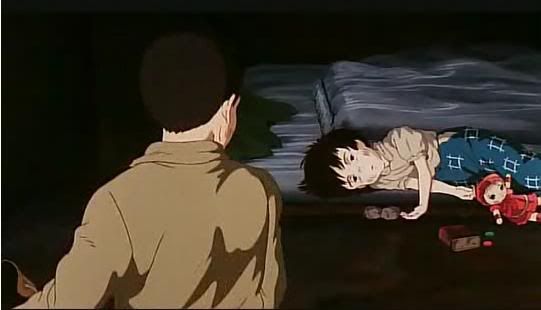 |
| Grave of the Fireflies Grave of the Fireflies definitely shows how important family and survival can become during times of struggle. Seita is the older brother to four year old Setsuko and must take on the responsibilities that have been placed on him due to the indifference of adults for the children outside their family. His love for his sister is shown in the way that he not only cares about her survival, but also wants to make sure that she is enjoying her childhood. During this horrifying ordeal he still takes the time to play with his little sister, comfort her, and try to give her the chance to be a child. He loves her enough to encourage her to play and be happy even though they are not in a difficult situation. The indifference that is directed towards himself and his sister is shown as soon as he arrives at his aunt’s house. Overall, she sees them as a burden and puts her own family’s wellbeing over theirs . She makes them feel as unwelcome as possible during their stay and that is what eventually drives Seita to try to survive somewhere else. The other adults in the film, like the farmer and the police officer, notice that these children are suffering, but in the end do nothing to help them. The film makes these children as ephemeral as the fireflies because they were given only a short time of happiness before their lives ended because of malnutrition. In Samuri from Outer Space it was discussed how even loved main characters can die unnecessarily. What makes Seita and Setsuko immortal is the existence of the film itself and how this portrayal of death could affect how others view war and its effects on the citizens. In both the animated film and in Nosaka’s narrative Hotaru no haka, the children are portrayed as victims of both the war and society’s indifference. They are both sorrowful tales that are done in a Kansai dialect. The differences in these two stories come from Nosaka’s own experiences, which the narrative is based off of. He put more blame on himself for his younger sister’s death than he did on society. |
Friday, March 9, 2012
Simms - Life and Death in Anime
 |
| Harp of Burma |
Mizushima’s journey is an example of how anime will look at the universe from an amoral point of view. The young soldier was someone who helped keep the spirits of comrades up and was obviously important to the rest of the men. However, the story ends with Mizushima taking on a somewhat morbid task that will take over the rest of his life. This highlights, though, the nobility of his character and the sacrifices that he is willing to make. It could also probably be an example of mono no aware, that having this constant reminder of death is giving Mizushima a greater appreciation of life.
It’s interesting how the movie is more focused on the aftermath of the war compared to the fighting that took place. The main Japanese division that the film was focused on had more of a desire to return home that to continue fighting against their enemies. Many of their comrades’ remains were left to decay in a land away from their loved ones. It even showed how one Japanese troop did not want to accept that there was surrender. This was also highlighted in Letters to Iwo Jima, also, when it portrayed Japanese soldiers chose to end their lives instead of risking capture by their enemies. I think it is good to look at how different films portray different cultures motivations during war times.
I think that it’s interesting that anime takes a different approach to the subject of suicide than American television does. In anime, sometimes suicide is looked at as a noble sacrifice in some cases or an honorable act. It is sometimes see as selfish or as a form of protest. The most important point is that anime will actually confront this topic. The subject of death and suicide is not downplayed or ignored in a way that some American shows handle it. In American television is may be seen as an act of cowardice or mental instability, and most of the time it is a taboo subject. I think that Japanese anime deals with the fact that tragic deaths and bad things happening to good people is a part of life that cannot be ignored.
Friday, February 17, 2012
Simms - Technology vs. Humanity
 |
| What makes us human? |
The movies we have dealt with so far have shown that technology can sometimes be more harmful than beneficial to the human condition. Sometimes it can lead to an individual feeling uncertain about their own humanity as technology becomes more advanced and it can definitely have an impact on their mental stability. In Akira, for example, we are given a character who has always felt like a victim most of his life, but is finally given the technology that will allow him to defend himself instead of needing saving. Tetsuo does not see the danger of so much power because he sees how he can change his identity to become the person he always wanted to be. Eventually, he loses both the physical appearance and personality that identified him. In the other anime, Perfect Blue, it is shown how sometimes who we are to others can affect how we view our identity. Technology has exposed Mima to a wide audience of people who judge her every move and action. The approval of these people who claim to be her fans threaten how Mima feels about herself because she is constantly changing to try to be who they want her to be. The stress of trying to figure out who she is (a pop star, actress, or just Mima) causes her to have a breakdown. Finally, Ghost in the Shell deals with the concept that our physical, human body is what is the most important part of our identity. I think that identity in Ghost in the Shell brings up the issue of, after so many cyborg enhancements, when does a person stop being human? The Major questioned who she was because one of her main purposes was to use her cybernetic body to serve her job. Section 9 was who created her, so it probably makes her whether she is her own person or who the section created. I think that all films show that everyone will question who they are and the type of person they are becoming at some point in our life. We all worry about losing qualities of ourselves that we believe makes us human. Even those around will impact how we feel regarding these issues.
Friday, February 10, 2012
Simms - Who is Mima?
 |
| Perfect Blue The objectification of women in the media is clearly shown in Perfect Blue. It seemed as if the men in Mima’s life were the ones that were contributing to her worth. No one took the time to ask her about the situations that she was being put in, and that caused her to go along with what she felt obligated to do for her acting career. Even Mima’s fans seemed to care more about her body and their image of her than they did about her as an individual. The producers of the show and the photographer for the magazine she was in seemed to be focused more about displaying her sexuality and the rape scene and the nude photo shoot were two things that Mima did not seem to want to be a part of. However, Mima once again puts the demands of others over what she really wants. Everyone in the movie (including her stalker, manger, and assistant) seem to have more say in her life than she does. In the end, she was becoming a puppet that others were manipulating. That also brings up the idea of an unstable identity. I felt as if Mima’s sense of self was dependent upon those around her. Rumi’s actions, like starting the “real Mima” website, confused Mima and made her question whether she could trust her own memories. Even the acting she was doing in the movie made the line between herself and the character she was playing blur. Mima was giving up so much of herself that when she tried to stop and think about who she really was, she could only depend upon who she was in relation to those around her. I thought that there were many similarities between Black Swan and Perfect Blue. Both movies had characters that had an onset of schizophrenia in response to the stress that they were feeling from their respective careers. I think that both characters felt very alone in their struggles because when they tried to tell someone what they were going through they were quickly dismissed. However, I don’t think that Mima let her career consume her as much as the lead in Black Swan did. |
Friday, February 3, 2012
Simms - The Lone Rider in Cowboy Bebop
 |
| Spike Spike’s statement that he was only going against Vincent for the money was contradicted by the fact that he was going through extreme lengths to find him, lengths that almost got him killed. I don’t know if he would have risked that much if it was just for the money. For instance, there was the scene on the train that almost got Spike killed when he was shot by Vincent. After that incident took place Spike could have walked away from it all because he would not be getting the money, and at the same time he would have realized that Vincent was more than just a terrorist. Another scene which demonstrated how Spike’s past fears and anxieties go against his “just for the money” talk is when he decides to face Vincent by himself in the final battle. I think it shows how he is trying to face his past fears by himself and that maybe he believes that beating Vincent will allow him to move on in a way. I saw Rashid as one of Spike’s few resources to the truth throughout the film. Most of his information on Vincent has come from Rashid, and even when it shows that he knows Rashid’s true identity he still depends on the information that he is being given. He depends on him, but he does not necessarily trust him. I saw Elektra as being a kindred spirit to Spike. She is just as determined to get the information needed about Vincent and they are going through extreme lengths to get to him. Also, when they are in the jail cells together it is revealed that they have both lost someone that they love. However, the most interesting relationship is the one between Vincent and Spike. These are two characters who are troubled by their past and in search of the truth. Spike’s past is motivating him to find out the truth about Vincent, and Vincent’s lack of knowledge about his past is what is pushing him to find out the truth about “purgatory”. They are both loners who don’t usually seem to want the aid of others in their mission and see one another as obstacles. |
Subscribe to:
Posts (Atom)